
What happens when a camera’s Edge AI meets a real security incident? We decided to find out.
By Ruthwik Shetty, Customer Success Engineer, Sentry AI
We ran two real-world field tests, not simulations, at active construction sites, comparing on-camera Edge AI with Sentry AI’s centralized GPU platform.
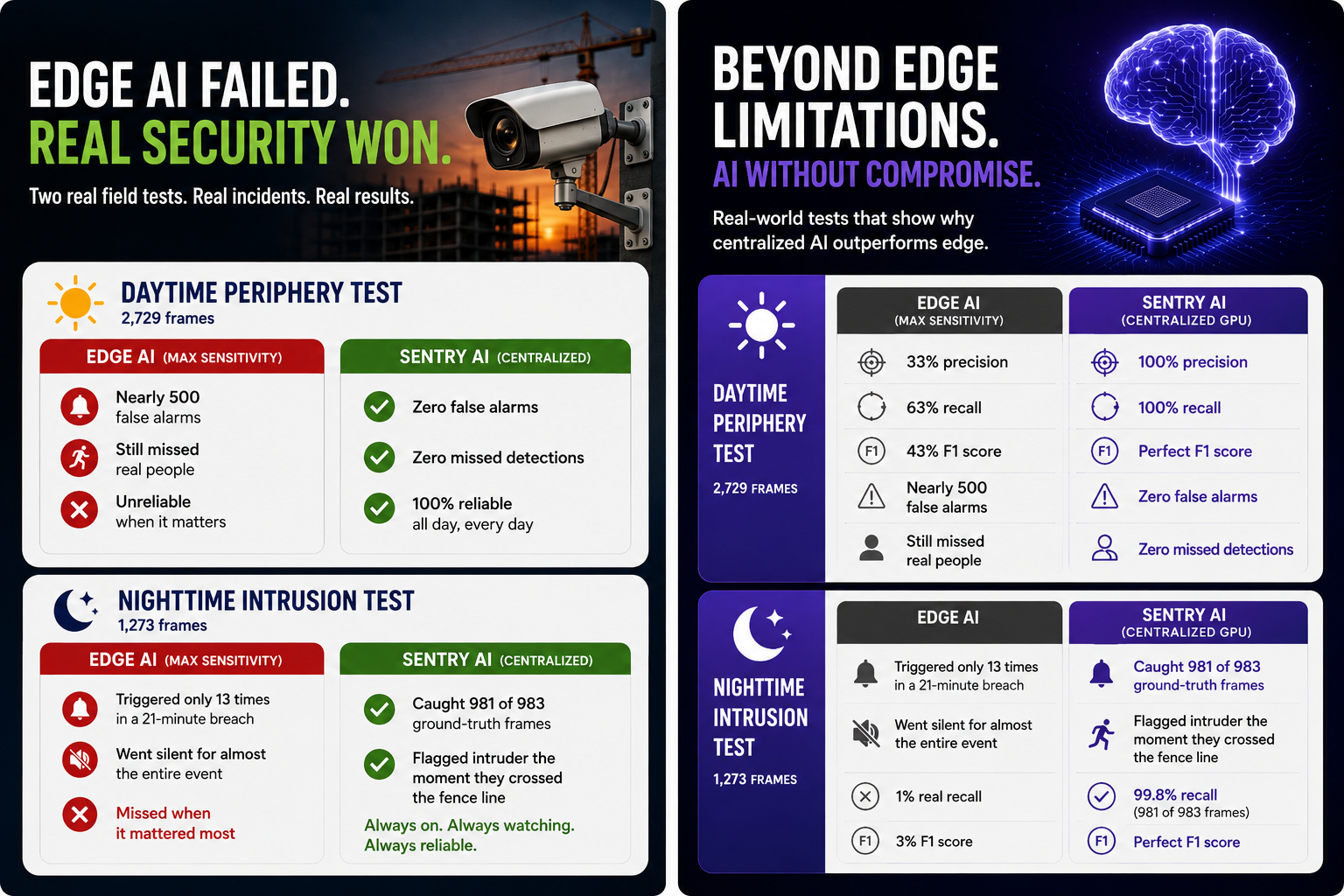
Daytime Periphery Test with 2,729 Frames
Edge AI at maximum sensitivity delivered 33% precision, 63% recall, and a 43% F1 score, generating nearly 500 false alarms while still missing real people.
In comparison, Sentry AI achieved 100% precision and 100% recall, with zero false alarms and zero missed detections.
Nighttime Intrusion Test with 1,273 Frames
This is where the numbers became even more telling. Edge AI showed 100% precision, but triggered only 13 times during a 21-minute breach. Its actual performance dropped to just 1% recall and a 3% F1 score.
Sentry AI detected 981 of 983 ground-truth frames, achieving 99.8% recall and identifying the intruder the moment they crossed the fence line.
What do these numbers tell us?
Precision alone can create a false sense of security.
If a system rarely triggers, it can look highly “accurate” on paper. But in physical security, missing an actual intrusion matters far more than avoiding a false alarm.
Edge AI operates within hard constraints—power, heat, compute, and on-chip memory. Centralized GPU inference can process significantly more context without those same limitations.
The real test of security AI isn’t how good it looks in a benchmark. It’s whether it catches the incident when it actually happens.